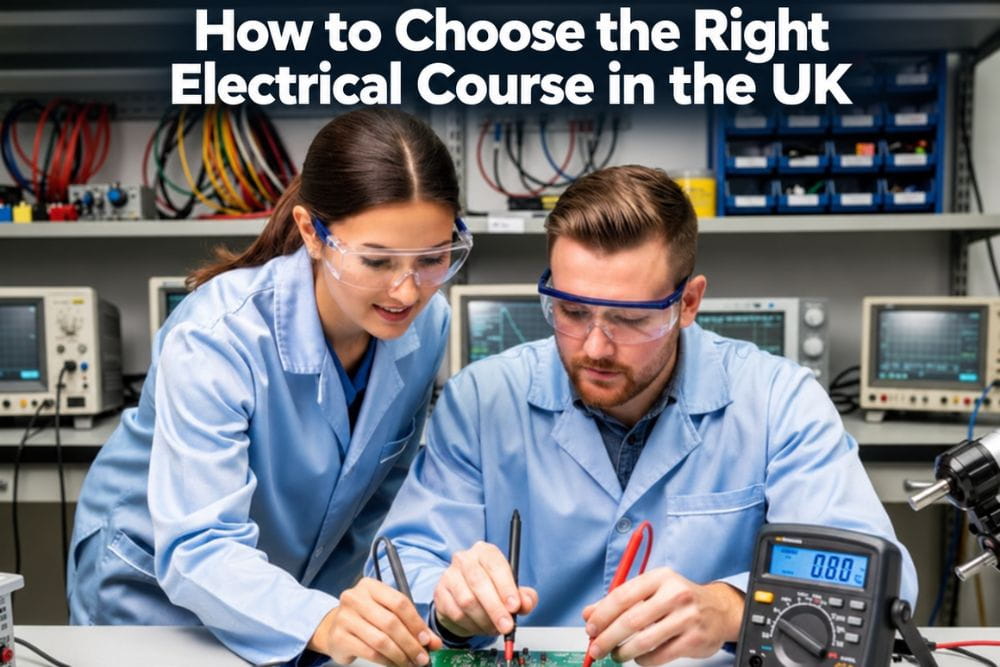
The EAL Inspection and Testing Course helps electricians learn how to test and check electrical systems safely. It teaches both theory and hands-on skills. You will learn how to test new and old systems, fill in reports, and follow BS 7671 Wiring Rules.
The guide explains what the course includes, how long it lasts, and what you need before joining. It also shows how the EAL course compares with City & Guilds and what it costs in the UK.
What Is the EAL Inspection and Testing Course?
An EAL Inspection and Testing Course is a practical qualification for electricians. It teaches the theory and practice of inspecting, testing, and reporting on electrical installations. This includes both new systems (initial verification) and existing ones (periodic inspection).
The course is usually a Level 3 Award, such as the EAL Level 3 Award in Electrical Installation Inspection, Testing, Certification and Reporting. It gives electricians the skills to work safely, carry out tests, issue certificates, and complete reports. The training covers low-voltage systems, including single-phase and three-phase circuits.
It is approved by Ofqual and run by EAL (Excellence, Achievement, Learning) — a leading UK awarding body for engineering and building services. This Vocational Related Qualification (VRQ) includes hands-on work in condition reporting and is widely recognised across the UK as proof of professional skill and competence.
What the EAL Inspection and Testing Course Covers
The EAL Inspection and Testing Course teaches both theory and practice. You learn how to inspect, test, and report on electrical systems. The course may focus on new installations, existing systems, or both. Each version covers all the main skills used in the UK electrical industry.

- Initial verification: Learn how to check and test a new electrical system. You make sure it meets safety and performance rules before it is used.
- Periodic inspection and testing: Learn how to test older systems. You find faults, wear, or safety issues that may cause danger or break current rules.
- Safe isolation: Learn how to switch off and make a system safe before you start work. This helps prevent electric shock.
- Testing and certification: Learn how to use testing tools, run full tests, and fill in forms like the Electrical Installation Certificate or the Electrical Installation Condition Report (EICR).
- Health and safety: Learn key safety laws and best practices. You make sure all work is done safely.
- Dead testing: Practice tests done with no power on, such as checking wire continuity, insulation, and polarity.
- Live testing: Practice tests done with power on, like RCD (Residual Current Device) tests, earth fault loop impedance, and fault current checks.
- Functional testing: Make sure all systems and devices work as they should.
- Compliance: Learn how to follow the IET (Institution of Engineering and Technology) Wiring Rules (BS 7671) and Guidance Note 3.
- Documentation: Learn how to fill in reports, record test results, and write accurate notes for clients or inspectors.
Who the Course Is For, Assessments, and Learning Outcomes
Who the Course Is For
This course is for working electricians, skilled trainees, and people who test or inspect systems. It suits anyone who must meet current UK standards.
- Qualification Details: The qualification is usually offered at Level 3. It is awarded by EAL (Excellence, Achievement, Learning).
- Equivalency: The City & Guilds 2391 course. Both give the same skills.
- Recognition: Accepted by Ofqual, UK employers, and trade bodies.
- Entry needs: You should already know basic electrical theory and have a Level 2 or Level 3 qualification.
- Regulation knowledge: You must know the latest Wiring Regulations (BS 7671) (https://en.wikipedia.org/wiki/BS_7671).
- Progression: Good for final-year apprentices or experienced electricians aiming to join NICEIC (National Inspection Council for Electrical Installation Contracting), ECA (Electrical Contractors’ Association), or JIB (Joint Industry Board).
Assessment for the Qualification
You must pass both a theory test and a practical test.
- Written test: An open-book, on-screen exam. You may use IET Guidance Note 3 during it.
- Practical test: You show that you can inspect, test, and record results safely and correctly.
Learning Outcomes
- Know key laws and safety rules for electrical testing.
- Use correct methods for single- and three-phase systems.
- Carry out inspection and reports on existing systems.
- Understand the difference between new system checks and periodic tests.
- Record and explain test results clearly and correctly.
Duration & Delivery Options for EAL Inspection and Testing Course
The course includes both theory and practical work. It helps electricians gain real experience and get ready for their tests in less time.

Duration
- Typical duration: The course runs for 5 consecutive days, usually Monday to Friday.
- Assessment schedule: After the course, assessments are held over about 1.5 days. You complete both a written test and a practical test to gain the qualification.
Delivery
- Format: The training is classroom-based and takes place in approved centres across the UK.
- Structure: The course is intensive and mixes theory lessons with hands-on practice. You learn to carry out initial verification, periodic inspection, testing, and certification following BS 7671 standards.
- Previous experience: Learners must already have Level 2 or Level 3 electrical qualifications and a good understanding of wiring rules before starting.
EAL vs City & Guilds: What’s the Difference?
EAL and City & Guilds both offer Level 3 courses for Inspection and Testing. They teach the same skills but assess students in different ways. The table below gives a simple side-by-side comparison.
| Category | EAL (Excellence, Achievement, Learning) | City & Guilds |
| Assessment Style | Focuses on hands-on work. Learners test, inspect, and fill out forms like they would on site. | Uses written exams to test theory. Best for learners who like clear, set questions. |
| Exam Details | Fewer questions and more time for tasks. Learners can use notes or guides such as the IET book. | More questions in less time. No notes allowed, so you must remember key facts. |
| Regulation Updates | Updates courses fast to match the latest BS 7671 rules. | Updates take longer but follow a fixed format across centres. |
| Recognition | Accepted by NICEIC, ECA, and all UK employers. Holds the same value as City & Guilds. | Very well-known name in UK training. Trusted by employers and trade bodies. |
| Flexibility | Great for working electricians. Allows open-book tests and real job-style training. | Fixed structure for all centres. Suits those who like theory and formal exams. |
EAL Inspection and Testing Course Cost in the UK
The EAL Inspection and Testing Course in the UK costs between £750 and £950 plus VAT. The course usually lasts 4 to 5 days. Exact prices depend on the training centre, course setup, and test fees. Many approved centres across the UK run these courses often, so electricians and apprentices can book a date that suits them.
Last Thoughts
The EAL Inspection and Testing Course gives electricians the skills to test and certify electrical systems safely and correctly. It is a trusted Electrical Training Course that combines theory with real, hands-on learning. By completing it, you gain the knowledge to follow BS 7671 Wiring Rules and meet UK safety standards. Whether you choose EAL or City & Guilds, both lead to the same recognised qualification.
This course helps you build confidence, improve your career prospects, and meet the needs of modern electrical work across the UK.
Frequently Asked Questions (FAQs)
Q: What qualifications do you need before enrolling in the EAL Inspection and Testing Course?
A: You should already have a Level 2 or Level 3 electrical qualification and understand the basics of electrical theory. You also need good knowledge of the latest BS 7671 Wiring Regulations before starting the course.
Q: How long does the EAL Inspection and Testing Course take to complete in the UK?
A: The course usually lasts five days, followed by about 1.5 days of assessments. Training centres across the UK may offer flexible schedules for working electricians.
Q: Is the EAL Inspection and Testing qualification recognised by UK employers and trade bodies?
A: Yes. The qualification is approved by Ofqual and accepted by employers, trade bodies, and organisations like NICEIC, ECA, and JIB throughout the UK.
Q: How much does the EAL Inspection and Testing Course cost in the UK?
A: The course cost typically ranges from £750 to £950 plus VAT, depending on the training centre, location, and exam fees.
Q: Does EAL cover three-phase installations?
A: Yes. The course includes training on both single-phase and three-phase low-voltage systems used in domestic, commercial, and industrial settings.
Q: Does EAL inspection and testing qualify for EICR work?
A: Yes. After completing the EAL Level 3 Inspection and Testing qualification, you can carry out Electrical Installation Condition Reports (EICRs) as part of your professional work.
Q: How is the EAL exam structured?
A: The EAL exam includes an open-book written test that checks your knowledge of regulations and a practical exam where you perform real inspection and testing tasks following BS 7671 standards.