The right electrical course depends on four factors: experience, target job, budget and study time. Beginners start with the 2365 Level 2 Diploma, experienced workers without a formal qualification take the Experienced Worker Assessment (EWA), and qualified electricians pick a specialist add-on. Matching the starting point to the right route comes first.
Costs vary by provider, format and package inclusions. Advertised prices often exclude registration, exam, assessment and resit fees, so request an itemised quote in writing. Apprenticeship funding and Advanced Learner Loans can reduce the bill. Verify the awarding body on the Ofqual Register before paying a deposit.
Common mistakes include enrolling on an NVQ without site access, registering on the 2357 near its closing date, comparing advertised prices, expecting online-only courses to build practical skills, and booking the AM2 too early.
How do you choose an electrical course: Step-by-step guide?
To choose an electrical course, complete five steps in order before contacting providers. These steps cover the job goal, the experience level, the budget and study time, the qualification route, and provider verification. The five steps to complete in order before contacting providers are listed below.
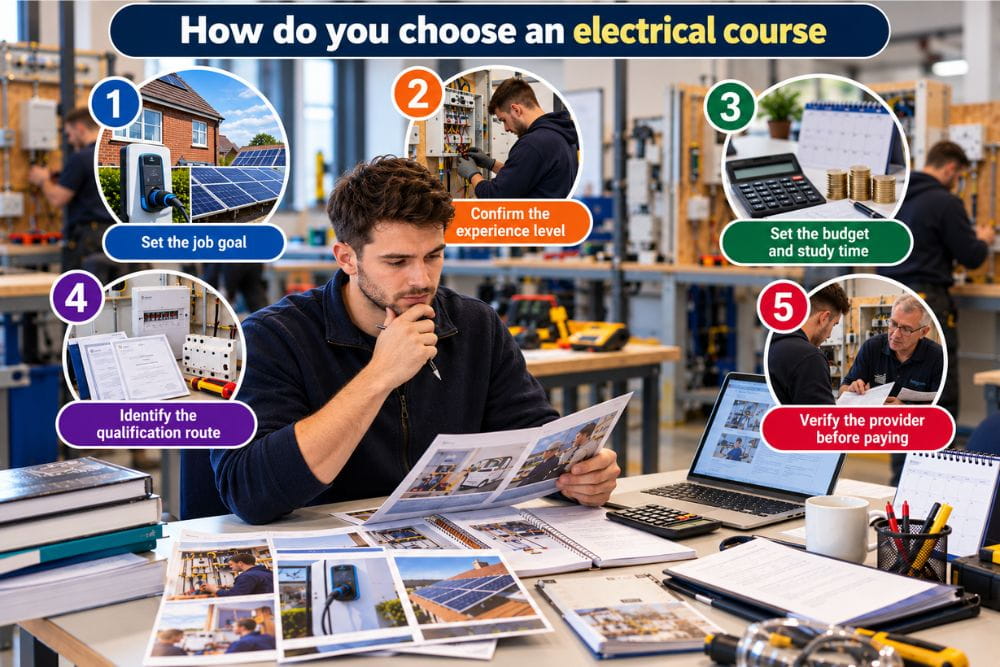
1. Set the job goal
Name the work type you want to perform: domestic installation, commercial installation, inspection and testing, EV (electric vehicle) charging, or electrical design. A fixed goal prevents payment for training that does not match the intended career. It also shows which qualification, add-on courses and site experience you will need later.
2. Confirm the experience level
Pick one of four groups: no electrical experience, some electrical training, working electrician without formal qualification, or qualified electrician seeking specialist training. This removes unsuitable routes immediately. Be honest about site hours and certificates, because entry requirements and portfolio rules depend on proven experience, and the wrong starting point wastes both time and money.
3. Set the budget and study time
Record the maximum total spend and the weekly hours available. Both figures decide between full-time, evening, weekend, and home-study formats. Include registration, exam, assessment and resit fees in the budget, and check whether apprenticeship funding or an Advanced Learner Loan applies. Realistic limits keep you from choosing a course you cannot finish.
4. Identify the qualification route
Match the experience group to a pathway: Level 2 for beginners, EWA for experienced workers, specialist courses for qualified electricians. Check the qualification code and entry requirements for each route, and confirm that it leads to the outcome you want, such as the Level 3 NVQ, AM2 assessment or ECS Gold Card.
5. Verify the provider before paying
Check accreditation and certification with the awarding body, and confirm the qualification number on the Ofqual Register. Read reviews and testimonials from past learners, then compare them with the course specification. Confirm funding, assessment fees and resit fees in writing before paying any deposit, so no hidden costs appear later.
What types of electrical courses available in the UK?
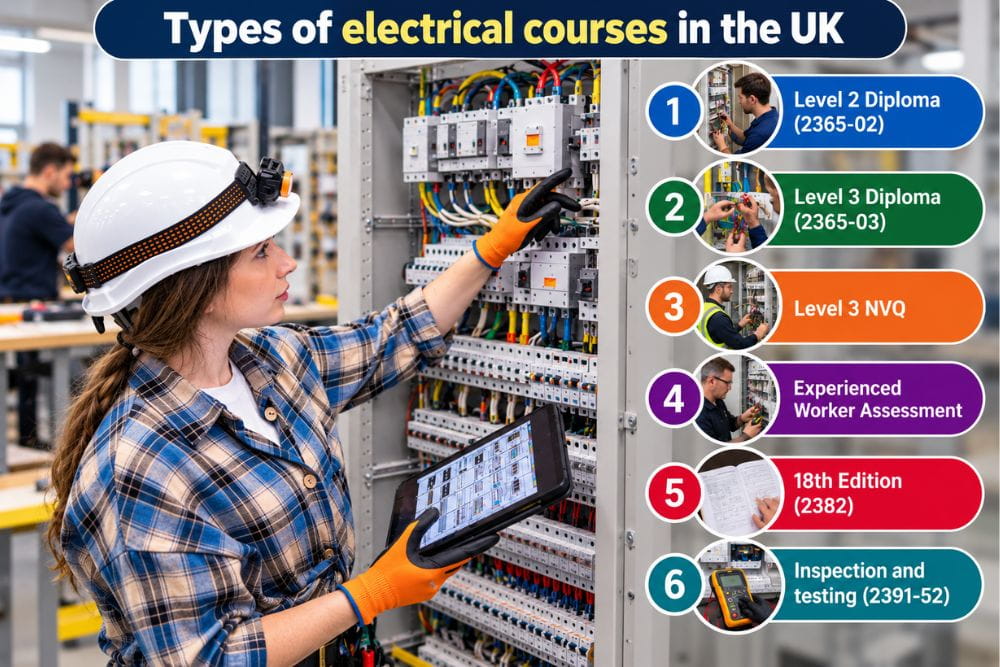
Electrical courses in the UK fall into four groups: classroom diplomas, work-based qualifications, practical assessments, and specialist add-ons. Each group serves a different career stage. Four course groups are described below, from classroom diplomas to specialist add-ons.
Classroom diplomas
Classroom diplomas deliver theory and practical training in a training centre. Two diplomas covering the core stages are listed below.
- Level 2 Diploma (2365-02): The entry-level classroom diploma. It accepts learners aged 16 and over, with no prior experience. Content covers health and safety, electrical science, and installation methods. Intensive full-time delivery runs about 10 weeks, and college delivery spans an academic year.
- Level 3 Diploma (2365-03): The follow-on diploma. Enrolment requires a Level 2 electrical installation qualification or an accepted equivalent. Content adds fault diagnosis, inspection and testing, and installation design. Intensive full-time delivery runs about six weeks.
Work-based qualifications
Work-based qualifications prove competence on live installations. Three work-based routes are listed below.
- Level 3 NVQ (National Vocational Qualification) 5357: The 5357 Level 3 Electrotechnical Qualification is a portfolio of site evidence. Entry requires a Level 3 technical qualification, such as the 2365-03 Diploma or an accepted equivalent. The portfolio requires varied installation work to cover every performance unit. City & Guilds closes the predecessor 2357 to new registrations on 31 October 2026 and names the 5357 as its successor. The 5357 code also appears in the Level 3 installation and maintenance apprenticeship.
- Experienced Worker Assessment (EWA, codes 2346 and 2347): The EWA gives experienced workers a Level 3 route without a beginner’s course. Candidates submit a work-based portfolio and sit the AM2E practical. Code 2346 covers installation and maintenance and requires five years of practising experience. Code 2347 covers domestic work and requires three years, with the AM2ED as the practical. City & Guilds also requires a Level 2 electrical technical qualification at entry.
- Domestic electrician routes: Domestic routes focus on work in homes. The Domestic Electrician apprenticeship (standard ST1017) uses the 5393 on-programme qualification and ends with the AM2D. Commercial and industrial sites fall outside that scope. Ask the provider which Electrotechnical Certification Scheme (ECS) card the route leads to.
Practical assessments
Practical assessments test safe installation, inspection, testing, and fault finding on a workshop rig. The AM2 (Achievement Measurement 2) closes the NVQ route. Four AM2 variants are listed below.
- AM2S: Installation and maintenance apprenticeships.
- AM2D: Domestic apprenticeships.
- AM2E: Experienced workers on the installation and maintenance route.
- AM2ED: Experienced workers on the domestic route.
Experienced worker candidates book the AM2E or AM2ED separately with an assessment centre. Providers list the AM2 fee separately or inside a package. Ask which applies.
Specialist add-ons
Specialist add-ons extend the scope of a qualified electrician. Four examples are listed below.
- 18th Edition (2382): BS 7671 wiring regulations.
- Inspection and testing (2391-52): Initial verification and periodic inspection.
- EV charging (2921-34): Charge point design and installation.
- Solar PV (2922-34): Small-scale solar photovoltaic installation.
The post-qualification section below lists seven add-ons.
Which electrical course should you take first?
The starting point decides the first course. Five starting points are listed in the table below, each matched to a route, a first course, and a next step.
Starting point | Route | First course | Next step |
No experience | Beginner route | 2365 Level 2 Diploma | 2365 Level 3 Diploma |
Some site work, no qualification | Improver route | Level 2 and Level 3 Diploma package | Level 3 NVQ (5357) |
Three or more years of unqualified work | Experienced Worker route | Experienced Worker Assessment (2346 or 2347) | AM2E or AM2ED practical assessment |
Qualified, regulations out of date | Update route | 18th Edition (2382) | Inspection and testing (2391-52) |
Qualified, wants a new skill | Specialist route | EV charging (2921-34) or Solar PV (2922-34) | Electrical design (2396-01) |
Each row names one first course and one progression step. The next step in each row is available only after the first course is complete.
Which electrical course route suits your situation?
5 situations cover most learners. Five situations are listed below, each with the first qualification, the key constraint, and the progression step.
5 situations cover most learners. Five situations are listed below, each with the first qualification, the key constraint, and the progression step.
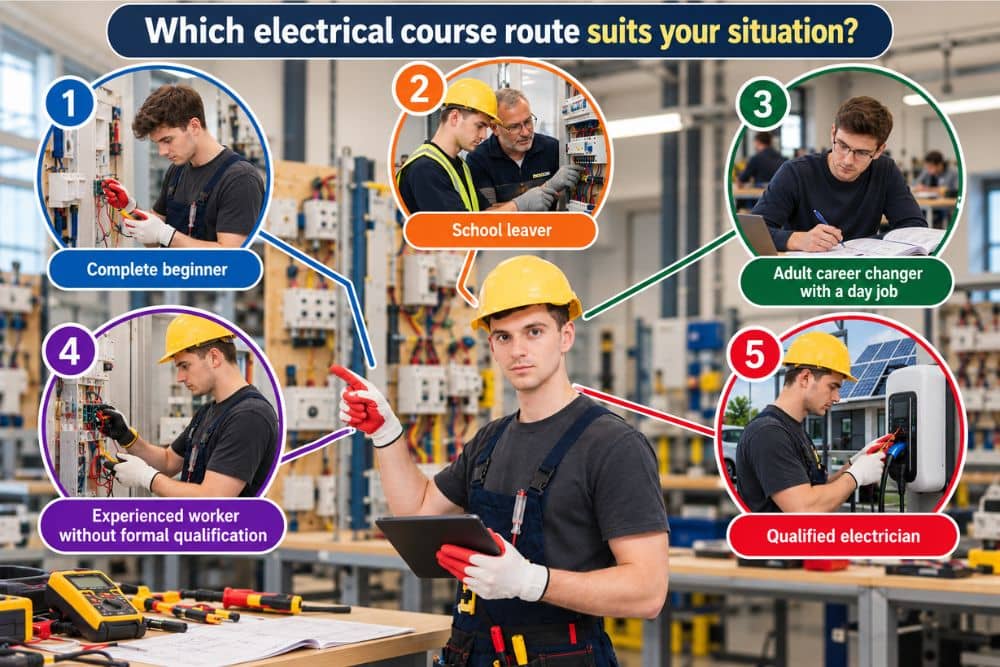
- Complete beginner: The 2365 Level 2 Diploma starts the beginner route, followed by the 2365 Level 3 Diploma. Full-time packages combine both in 13 to 16 weeks. The Level 3 NVQ follows after site work starts.
- School leaver: An apprenticeship pairs paid employment with training. The installation and maintenance standard typically runs 48 months of training plus about six months of end-point assessment. The domestic standard runs 36 months. Full-time college courses are free for learners aged 16 to 18 who meet residency rules.
- Adult career changer with a day job: Evening and weekend delivery fits a day job and stretches each diploma over several months instead of weeks. The NVQ stage requires a site work placement.
- Experienced worker without formal qualification: The EWA validates existing skills through a portfolio, so the Level 3 diploma and NVQ are not repeated. Eligibility depends on the years of practising experience required by code 2346 or 2347. The AM2E or AM2ED practical follows the portfolio. Gold Card eligibility depends on passing the AM2 variant for the chosen route.
- Qualified electrician: Specialist add-ons suit a qualified electrician. The 18th Edition updates BS 7671 knowledge, the 2391-52 covers inspection and testing, and the 2921-34 and 2922-34 cover EV charging and solar PV. Choose based on incoming work.
How does your career goal change the electrical course choice?
Career goal changes the add-on courses more than the core route. Five career goals are mapped in the table below to a route and add-on courses.
Career goal | Matching route | Add-on courses |
Domestic work | Domestic apprenticeship, domestic EWA (2347), or full route | 18th Edition, 2392 Fundamental Inspection and Testing |
Commercial and industrial work | Full route (Level 2, Level 3, NVQ, AM2) | 2391-52 Inspection and Testing, 2396-01 Design and Verification |
Self-employed work | Full route | 18th Edition, 2391-52 Inspection and Testing |
EV charging and solar | Qualified installer first | 2921-34 EV Charging, 2922-34 Solar PV, 2923-34 Electrical Energy Storage Systems |
Maintenance work | Level 3 NVQ (5357) with a maintenance focus | 2377-77 PAT (portable appliance testing), safe isolation |
Four of five goals build on the Level 3 qualification. Domestic work alone has a dedicated apprenticeship and a dedicated experienced worker route.
What should you compare before paying for an electrical course?
8 checks separate a verifiable provider from an unverifiable one. Eight checks are listed in the table below, each with what to confirm and the evidence to request.
Check | What to confirm | Evidence to request |
Awarding body | Named body on the certificate, such as City & Guilds, EAL, or LCL Awards | Qualification number and approved-centre listing |
Entry requirement | Age, prior qualification, maths and English | Written entry criteria |
Duration | Weeks in centre, study days, exam dates | Sample timetable |
Total cost | Course, registration, exam, and assessment fees | Itemised quote |
Practical time | Hours on rigs and maximum class size | Workshop tour or kit list |
Assessment and resits | Exam format, resit fee, number of attempts, retake window | Written resit policy |
AM2 and placement | AM2 fee, preparation days, NVQ placement support | Written confirmation |
Deposit and refunds | Deposit amount and refund terms if the start date moves | Written refund policy |
Each check ends in a document. A provider that cannot supply the document fails the check. Request every answer in writing and save the replies.
How do you verify accreditation and the awarding body?
To verify accreditation, check two registers. Two registers are listed below.
- Ofqual Register of Regulated Qualifications: Search the qualification by name and number.
- Awarding body approved-centre list: Search the centre on the list of the body issuing the certificate.
City & Guilds, EAL, and LCL Awards are three awarding bodies in this field. A course title without a qualification number cannot be verified.
How much does an electrical course cost?
Electrical course cost depends on the provider, delivery format and package inclusions. Advertised prices often exclude registration, exam, assessment and resit fees, so compare itemised quotes. Apprenticeships are funded up to £20,000 (installation and maintenance) or £15,000 (domestic). Adults aged 19 or over may use an Advanced Learner Loan for Level 3 courses, or Free Courses for Jobs for the Level 2 Diploma. Confirm eligibility before enrolling.
Which learning format fits an electrical course best?
Delivery format changes the timeline and the amount of hands-on practice. Five delivery formats are compared in the table below by suited learner and trade-off.
Delivery format | Suited to | Trade-off |
Full-time weekday | Learners without a job commitment | Weeks away from work |
Evening | Learners with a day job | Longer overall duration |
Weekend | Learners with weekdays unavailable | Spread over more weeks |
Home study plus centre weeks | Self-directed learners | Fewer weeks of supervised practice |
Online only | Theory-based courses such as the 18th Edition | No hands-on practice |
Hands-on practice decreases from the first row to the last. Online-only delivery carries none.
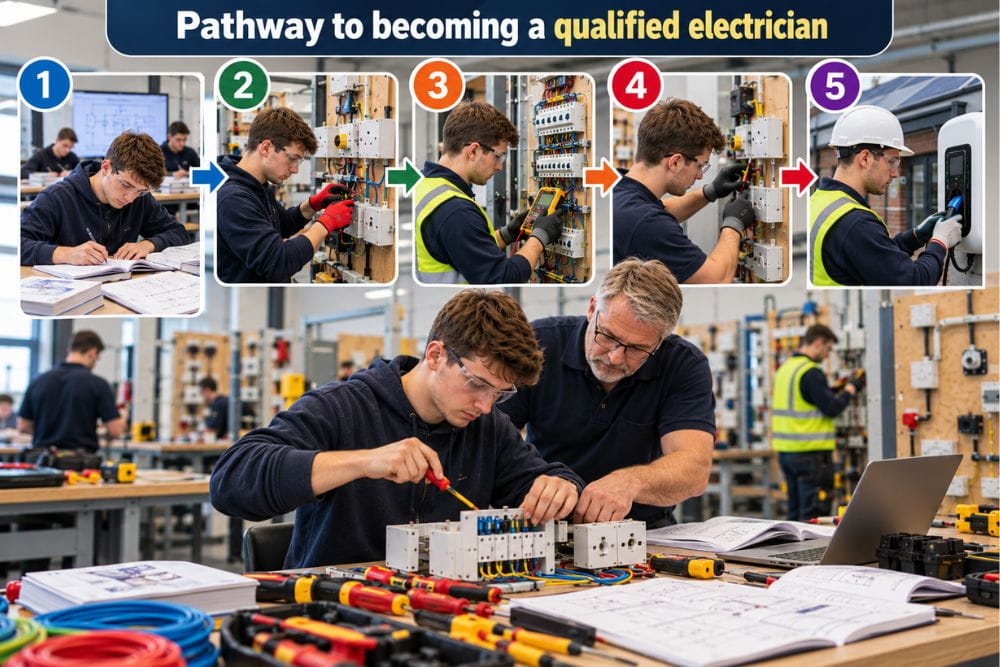
What is the pathway to becoming a qualified electrician?
The adult pathway has six stages: the 2365 Level 2 Diploma, the 2365 Level 3 Diploma, the Level 3 NVQ (5357) with site evidence, the AM2 practical assessment, the 18th Edition certificate, and the ECS Gold Card application. Apprentices and experienced workers follow variants of this order. Timelines depend on site access. The Gold Card also requires a pass in the ECS Health, Safety and Environmental assessment. After qualifying, add specialist courses such as inspection and testing, EV charging, solar PV or electrical design.
How do you spot a weak electrical course provider?
6 warning signs recur across weak providers. 6 warning signs are listed below, each with a matching check.
- No named awarding body: Ask to see a sample certificate.
- Guaranteed-pass promises: No provider can guarantee a pass. Request pass-rate evidence in writing.
- No workshop kit: Request a tour or photographs of the rigs.
- Cash-only payment without a receipt: Request an invoice and payment terms.
- No written resit policy: Request the policy before paying.
- Course titles without qualification numbers: Search the number on the Ofqual Register.
Which mistakes cost electrical course learners time and money?
These mistakes cost learners time and money. 5 mistakes are listed below, each with the fix.
- Enrolling on an NVQ without site access. The portfolio requires varied live work.
- Registering on the 2357 near its closing date. The 5357 replaces it, so confirm which code the provider uses.
- Comparing advertised prices. Add registration, exam, assessment, and resit fees first.
- Expecting an online-only course to build practical skills. Only assessed hands-on work proves practical competence.
- Booking the AM2 early. The AM2 is the final component of the NVQ route. Book it for the end of the NVQ.
Which electrical course is right after all the checks?
Experience, target job, budget, and study time decide the right electrical course. Beginners start with the 2365 Level 2 Diploma. Experienced workers start with the EWA. Qualified electricians pick a specialist add-on. Each route ends with the same verification: confirm the qualification number, the awarding body, the total cost, and the resit terms in writing.
Frequently Asked Questions
Q: What is the difference between an electrical engineer and an electrician?
A: An electrical engineer designs, specifies and analyses electrical systems, usually with a degree. An electrician installs, tests and repairs those systems on site, usually through an apprenticeship or work-based qualification. Engineers work mostly with calculations and design software, while electricians work mostly with tools, cables and live installations.
Q: Does an electrical engineering degree include hands-on practical work?
A: Most electrical engineering degrees include laboratory sessions, but the amount varies widely by university. Some programmes use projects and workshops throughout, while others stay theory-heavy until later years. Check the module list for lab hours, project modules and industrial placements before applying.
Q: Why do electrical engineering degrees contain so much maths?
A: Maths underpins how engineers model circuits, signals, electromagnetic fields and control systems. Calculus, linear algebra and differential equations let engineers predict behaviour before anything is built. Roles in design, power systems and signal processing use this daily, while installation roles use far less.
Q: Do electricians need to be good at maths?
A: Electricians need practical, applied maths rather than advanced theory. Typical tasks include Ohm’s law, cable sizing, voltage drop, load calculations and unit conversions. Competence with algebra, percentages and formulas is enough for most installation and testing work.
Q: How can engineering students gain practical skills alongside their degree?
A: Students can build practical skills through placements, internships, university project teams and personal projects. Soldering, breadboarding, microcontroller builds and reading schematics all help. Employers often rate demonstrable projects as highly as grades because they show applied problem-solving.
Q: Can you get an electrical job with no experience?
A: Yes, but entry roles are usually apprenticeships, trainee posts or electrician’s mate and labouring jobs. Employers prefer candidates who show reliability, basic safety awareness and a willingness to learn. Certificates alone rarely replace site exposure, so combine any study with a route into paid work.
Q: Do specialist electrical courses help without work experience?
A: Specialist courses help most when they match a job you already do or have been offered. Without that experience, you may struggle to apply the skills or forget them. Many employers also run their own authorisation training, so a prior certificate may not shorten the process.
Q: How do you choose an electrical or electronic engineering specialism?
A: Start by sampling subjects through modules, projects and placements, then compare each field on interest, job demand, pay range and working conditions. Interest usually predicts long-term performance better than pay alone. Your first specialism does not lock in your career, as many engineers change direction later.
Q: Which trade skills help if you want to work in property renovation?
A: Useful skills include basic electrics, plumbing, plastering, carpentry and project management. Learn safe isolation and legal limits first, as some electrical and gas work must be done by registered professionals. Site experience as a labourer or assistant often opens more doors than short courses alone.
Q: What makes an electrical graduate stand out to employers?
A: Employers look for a mix of theory and practical ability. Graduates stand out with placement experience, completed projects, familiarity with schematics, basic programming and clear communication. Showing you can apply principles to real equipment matters more than listing modules.