
Finding a plumbing course close to home is more than a matter of convenience. Local training centres give you access to physical workshop facilities, real pipe systems, and assessors who can sign off on your practical competency, something an online-only course cannot provide. According to CITB’s Construction Skills Network, the UK construction sector needs over 224,000 new workers by 2027, with plumbing consistently listed among the highest-demand trades. If you’re looking to start training, this guide covers every decision point: the types of qualifications available, what they cost, how long they take, and what to check before you sign up.
Why is plumbing a good trade to train for?
Plumbing offers employment stability that few office-based roles can match. The skills don’t become obsolete; water systems, drainage, and heating will always need installation, repair, and maintenance. What changes over time is the complexity of systems, which means a continuous demand for qualified tradespeople.
Salary benchmarks from the ONS Annual Survey of Hours and Earnings show what progression looks like in practice:
- Newly qualified plumber: £25,000–£32,000 per year
- Experienced plumber (5+ years): £35,000–£45,000 per year
- Self-employed plumber: £50,000+ (variable by location and specialism)
Earning potential increases sharply once you add Gas Safe registration through ACS (Accredited Certification Scheme) assessments. Gas work commands a premium, and most domestic heating jobs require it. That makes Level 3 plumbing plus ACS the most common career path for those aiming at the higher end of the pay scale.
What kinds of plumber courses are available in the UK?
UK plumbing courses range from multi-year apprenticeships to short specialist programmes lasting a few days. The right option depends on where you are in your career, whether you’re starting from scratch, changing trades, or adding a qualification to existing skills. The three main routes are apprenticeships, vocational qualifications, and short courses, each serving a different stage of professional development.
Plumbing apprenticeships
An apprenticeship is the most structured route into the trade. The relevant standard is the Plumbing and Domestic Heating Technician Level 3 Apprenticeship, which combines on-the-job training with college study. Employers fund the training cost through the Apprenticeship Levy, so apprentices pay nothing for the qualification itself. You must be at least 16 years old, and you earn a wage throughout, typically starting at or above the National Minimum Wage for your age group.
The programme runs for approximately three to four years and ends with an End-Point Assessment (EPA). This route suits school leavers or those already working in a related trade who want a fully employer-backed path to qualification.
Vocational plumbing qualifications and NVQs
Vocational qualifications are the most common route for adult learners and career changers. The main options sit on the Regulated Qualifications Framework (RQF), which means employers and professional bodies recognise them nationally. Key qualifications include:
- City & Guilds 6035 (Level 2): Covers cold and hot water systems, central heating, and basic drainage
- BPEC Level 2 Award in Plumbing: Widely recognised by employers, particularly for domestic work
- NVQ Level 2 in Plumbing and Heating: Competency-based, assessed in a real work environment
- NVQ Level 3 in Plumbing and Heating: Covers system design and commissioning, required for more complex residential and commercial installations
Level 2 focuses on installation and maintenance. Level 3 moves into design, fault diagnosis, and commissioning. Most employers expect at least Level 3 before considering a candidate for unsupervised site work.
Specialist and short plumbing courses
Short courses typically run from one to ten days and target people already working in the trade who need to add a specific skill. They are not suitable as a first qualification, as they assume a baseline of existing knowledge.
Common short courses include:
- Unvented Hot Water Systems (G3): Required by law to work on pressurised systems above certain volumes; highly sought after and well paid
- Drain lining courses: Cover no-dig pipe rehabilitation techniques used in drainage maintenance; relevant to those moving into drainage contracting
- Legionella awareness: Required for commercial property work
- Water regulations awareness
If you’re already qualified and want to increase your day rate or move into a specialism, these courses offer a direct return on investment.
How much does a plumbing course cost in the UK?
Course fees vary by qualification level, provider, and whether assessment costs are included. As a general guide:
Course type | Typical cost |
Short courses (1–10 days) | £500–£2,000 |
Level 2 City & Guilds / BPEC | £1,500–£3,500 |
Level 3 full qualification | £3,000–£6,000+ |
Apprenticeship | Free to the apprentice |
Always check whether the quoted fee includes registration and assessment charges. Some providers list tuition costs only, then add exam fees and materials separately, which can add several hundred pounds.
What funding is available for plumbing courses?
Advanced Learner Loans are government-backed loans available for RQF Level 3 qualifications and above. They work similarly to student loans, repayable only once you earn above the repayment threshold. You apply directly through the Student Loans Company.
CITB grants are available to employers registered with CITB. If your employer pays the CITB levy, they can claim back a portion of your training costs. This is worth raising with your employer before self-funding a course.
Some local councils and combined authorities also run Skills Bootcamp programmes that cover plumbing fundamentals at reduced or no cost. Availability varies by region, so check the National Careers Service website for current funded options in your area.
How long does it take to train as a plumber?
The honest answer is: it depends on the route. Here is a clear breakdown:
Route | Duration |
Short specialist course | 1–10 days |
Level 2 (full-time) | 6–12 months |
Level 3 (full-time) | 12–18 months |
Level 3 (part-time) | 2–3 years |
Apprenticeship | 3–4 years |
To work as a qualified plumber in the UK and to be taken seriously by employers, local authorities, and domestic clients, you need at least a Level 3 qualification plus documented site experience. The Level 2 alone is not sufficient for unsupervised work. Factor this in when comparing courses: the cheapest and shortest option may not produce the outcome you’re aiming for.
How do you find plumber courses near you?
The most reliable starting point is to check the directories of the main awarding and regulatory bodies. These list approved training providers by region:
- Alphabse: Centre-based plumbing training with practical workshop facilities
- CITB: Construction training providers with CITB approval
- City & Guilds: Approved centre finder
- BPEC: Registered training providers
- JTL Training: Specialists in plumbing and electrical apprenticeships
- Find a Learning Provider (findapprenticeshiptraining.apprenticeships.education.gov.uk) — government database of apprenticeship providers
When checking a local provider, confirm that their qualifications appear on the RQF and are accepted by CIPHE (Chartered Institute of Plumbing and Heating Engineering) or WIAPS (Watersafe Installer Approval and Promotion Scheme). Membership of these bodies is increasingly expected by local authorities and housing associations when tendering for contracts.
Online plumbing courses vs in-person training: What’s the difference?
Online plumbing certificates cover theory units only. BPEC, City & Guilds Level 2 and Level 3, and NVQ routes all require physical assessments with a qualified assessor. No full, recognised UK plumbing qualification can be completed entirely online.
Some providers offer blended learning theory modules delivered online, combined with block attendance at a training centre for practical assessment. This suits people balancing work or family commitments. Alphabse delivers this format, combining flexible study with hands-on sessions at a dedicated training facility. If you see a provider advertising a “full Level 3 online,” check what the qualification actually is before enrolling — it may be a knowledge-only unit rather than a complete vocational qualification.
What do plumbing courses cover?
Both Level 2 and Level 3 programmes follow a structured curriculum set by the awarding body. Core subject areas include:
- Cold and hot water supply systems
- Central heating installation and commissioning
- Drainage and sanitation systems
- Above-ground discharge systems
- Unvented hot water systems (G3) – where included in the programme
- Gas safety awareness (note: gas work itself requires a separate ACS assessment)
- Building Regulations Part G (sanitation and water efficiency) and Part L (conservation of fuel and power)
- Health and Safety at Work Act requirements and site safety
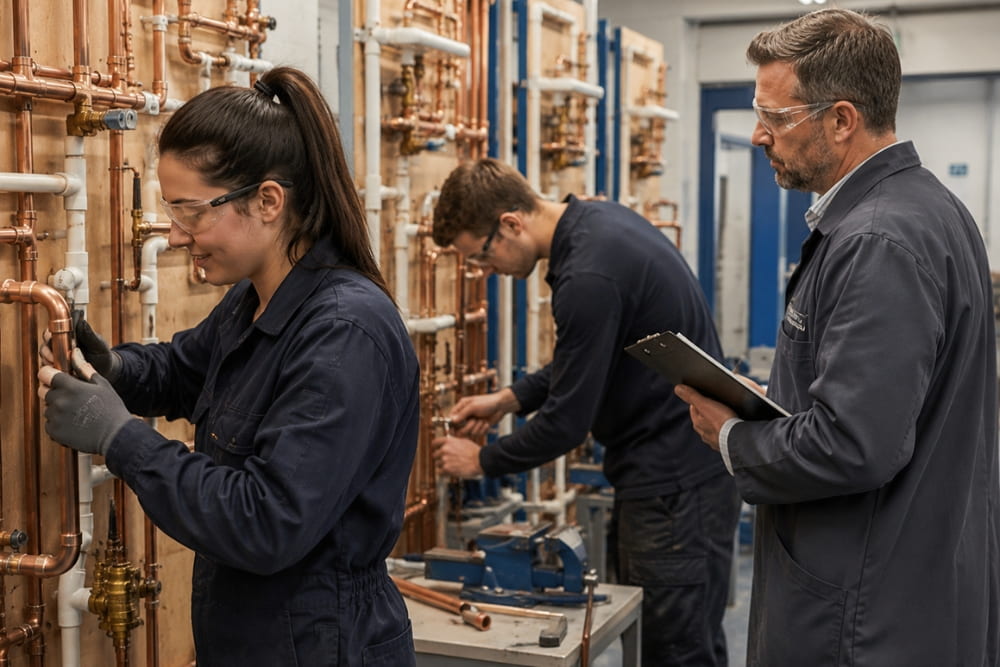
Practical training makes up a significant portion of the timetable at Level 2 and Level 3. You work on realistic installations in a workshop environment, cutting, joining, and commissioning pipe systems under trainer supervision before progressing to assessed practical tasks.
What are the entry requirements for plumbing courses?
Requirements differ depending on whether you’re a school leaver or an adult returning to education.
- School leavers applying for apprenticeships typically need GCSEs at grade 4 (C) or above in Maths and English. Some employers also ask for a Science GCSE. The minimum age for an apprenticeship is 16.
- Adult learners are usually assessed on aptitude rather than formal qualifications. Most providers ask you to complete a short numeracy and literacy test during enrolment. If you can measure accurately, read technical drawings, and follow written instructions, you are likely to meet the threshold.
All routes require a basic level of physical fitness. Plumbing work involves carrying equipment, working in confined spaces, kneeling, working at height, and spending long periods on your feet. If you have a medical condition that affects any of these, discuss it with the provider before enrolling; reasonable adjustments are often possible.
What can you do after completing plumber training?
After completing a Level 3 qualification, most plumbers pursue one or more of the following:
- Gas Safe registration via ACS: The Accredited Certification Scheme is the gateway to all domestic and commercial gas work in the UK. It is a legal requirement. ACS assessments are carried out by approved certification bodies, including Capita and BESCA. Passing them and registering with Gas Safe Register opens gas installation, servicing, and repair work, which is among the highest-paid work a plumber can take on.
- Employment options: Qualified plumbers work for housebuilders, maintenance contractors, social housing providers, facilities management companies, and specialist subcontractors. Entry-level salaries for newly qualified candidates sit between £25,000 and £32,000, rising with experience.
- Self-employment: Many plumbers move into self-employment within a few years of qualifying. This requires public liability insurance, a CSCS card (if working on construction sites), and Gas Safe registration if taking gas work. Self-employed rates vary significantly by region, with plumbers in London and the South East typically charging more than the national average.
- Specialisations: Those who want to move beyond general domestic plumbing often add qualifications in commercial heating, pressurised systems (G3), renewable technologies (heat pumps, solar thermal), or water treatment. Each specialism increases day rates and reduces direct competition.
How do you choose the right plumbing course provider?
Before committing to a provider, ask these specific questions:
- Is the qualification listed on the RQF and accepted by CIPHE or WIAPS? If the answer is vague, look elsewhere.
- What is the trainer-to-student ratio in practical sessions? A ratio above 1:8 in a workshop environment limits how much hands-on time you get.
- Are assessment and registration fees included in the quoted price? Get this confirmed in writing.
- Does the centre have employer links or a job board for completers? Providers with industry connections give you a practical advantage when job-seeking.
- Who are the trainers and what are their industry credentials? Trainers should hold a Level 3 qualification at a minimum, with recent industry experience, not just teaching experience.
What plumbing specialisations can you move into?
Plumbing offers genuine long-term progression. The path typically moves from Level 2 trainee to Level 3 qualified plumber, then through ACS registration to gas work, and eventually into senior technical roles or running your own business.
Specialisation routes that significantly increase earning potential include:
- Commercial heating engineer: Larger-scale heating systems in offices, schools, and hospitals
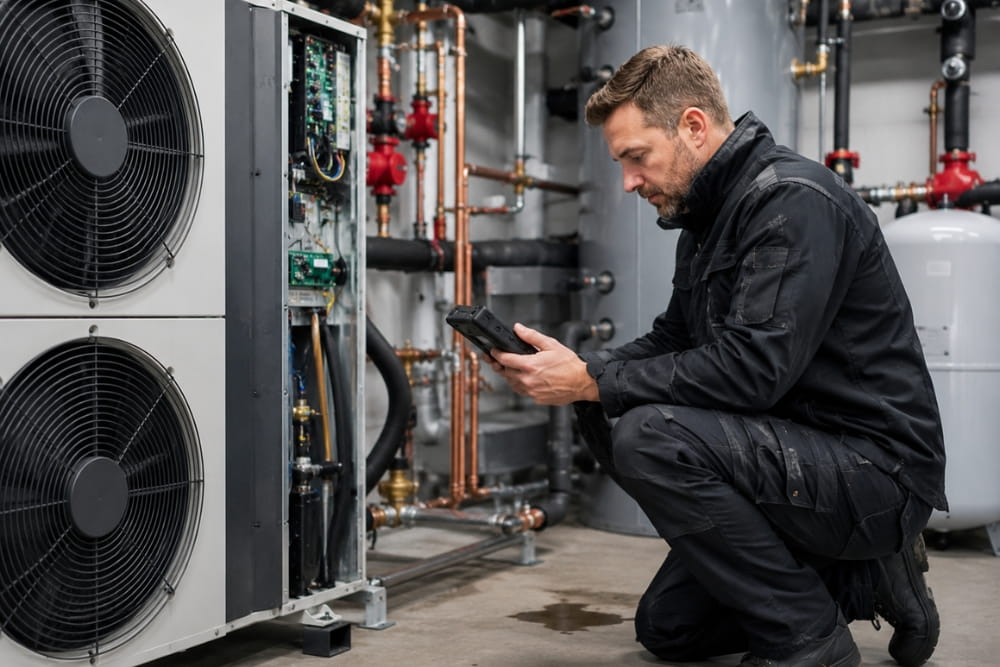
- Heat pump installer: MCS certification required for government-funded installations; demand growing sharply as the UK moves away from gas boilers
- Unvented hot water systems (G3 qualified): Required for high-pressure cylinder work; often added as a short course after Level 3
- Drain lining and rehabilitation: No-dig pipe repair work for drainage contractors; less physically demanding than above-ground plumbing
Each of these commands a higher day rate than general plumbing and places you in a smaller pool of qualified candidates.
Last thoughts
Plumbing qualifications in the UK follow a clear progression from Level 2 foundations through to Level 3, ACS gas registration, and specialist short courses. The route you take depends on your starting point, your budget, and how quickly you need to be earning. Before enrolling, verify that any course sits on the RQF, confirm what the fee actually includes, and check the trainer’s industry credentials. Local, centre-based training gives you the practical sign-off that employers and clients require, something no online certificate replaces. If you’re ready to compare providers or find a course near you, start with the awarding body directories listed above and shortlist centres that match your qualification goal.
Frequently Asked Questions (FAQs)
Q: How much does a plumbing course cost in the UK?
A: Short courses start from around £500. A full Level 2 qualification typically costs £1,500–£3,500, and Level 3 ranges from £3,000 to over £6,000 depending on the provider. Apprenticeships are free to the apprentice, as the employer funds training through the Apprenticeship Levy.
Q: How long does it take to train as a plumber?
A: A full-time Level 2 course takes 6–12 months. Level 3 takes 12–18 months full-time, or 2–3 years part-time. An apprenticeship runs for 3–4 years. Most employers expect at least Level 3 before treating someone as a fully qualified plumber.
Q: Can I train as a plumber while working full-time?
A: Yes. Part-time and blended learning options are available through many providers. Theory can often be completed online, with practical sessions delivered in block weeks at a training centre. Confirm the attendance requirements before enrolling to make sure they fit your schedule.
Q: What qualifications do I need to become a plumber in the UK?
A: The standard route is NVQ or City & Guilds Level 2 followed by Level 3 in Plumbing and Heating. These sit on the RQF and are recognised nationally. For gas work, you also need to pass ACS assessments and register with Gas Safe Register — this is a legal requirement.
Q: Are there any online options available for plumber courses?
A: Yes, many vocational schools and training providers offer online plumber courses that provide flexibility for students to study at their own pace from anywhere with an internet connection.


